Random Facts and Places That Make San Antonio Unique
San Antonio stands apart from other Texas cities because of its deep Spanish colonial roots, historic missions, cultural traditions, riverfront attractions, and unusual landmarks that blend history with modern tourism. Founded in 1718, the city remains one of the oldest continuously inhabited European-established settlements in Texas and continues to preserve major pieces of its early history.
From UNESCO-listed missions and underground caverns to public art installations and vibrant cultural districts, San Antonio offers a mix of historic sites, local traditions, and attractions that give the city a character unlike anywhere else in the state.
San Antonio Is One of Texas’s Oldest Cities
San Antonio officially traces its founding to 1718, when Spanish explorers and missionaries established Mission San Antonio de Valero, later known as The Alamo, along the San Antonio River.
Soon after, the Spanish also established Presidio San Antonio de Béxar and the civilian settlement known as Villa de Béxar, helping create one of the earliest organized Spanish communities in Texas.
The settlement grew because of its reliable river access, fertile land, and position along important Spanish colonial routes connected to El Camino Real.
Today, many of San Antonio’s oldest districts still reflect this early Spanish influence through architecture, plazas, churches, and historic landmarks.
The River Walk Extends Far Beyond Downtown
The San Antonio River Walk is one of Texas’s best-known attractions, but many visitors do not realize how large the system has become.
The downtown section, often called Paseo del Rio, features restaurants, hotels, shops, bridges, and river barges winding through the center of the city. Beyond downtown, the River Walk extends into the Museum Reach and the Mission Reach, creating a much larger network of trails, public art, and riverfront pathways.
The Mission Reach section connects several historic missions south of downtown through hike-and-bike trails and restored river ecosystems.
Visitors can explore parts of the River Walk by:
- Walking
- Cycling
- Kayaking
- Boat tours
- Scooter rentals
The combination of tourism, public recreation, and environmental restoration helps make the River Walk one of San Antonio’s most recognizable features.
San Antonio’s Spanish Missions Are a UNESCO World Heritage Site
San Antonio is home to the only UNESCO World Heritage Site in Texas.
The San Antonio Missions, including Mission Concepción, Mission San José, Mission San Juan, and Mission Espada, together with The Alamo, form a group of Spanish colonial mission sites established during the 18th century.
These missions were designed as religious, agricultural, and community centers during Spanish colonization. Today, they remain some of the best-preserved examples of Spanish colonial architecture in the United States.
Many mission features still survive, including:
- Stone churches
- Frescoes and carvings
- Irrigation systems called acequias
- Courtyards and defensive walls
- Historic farmland areas
Several of the missions remain active Catholic parishes while also operating as major historic and cultural sites.
Mission San José and the Famous Rose Window
Among San Antonio’s missions, Mission San José is often considered the most architecturally impressive.
Founded in 1720, the mission became known as the “Queen of the Missions” because of its large church complex and detailed stonework. One of its most famous features is the ornate Rose Window, carved into the church’s limestone wall during the 18th century.
The window is regarded as one of the finest examples of Spanish Colonial decorative stone carving in the United States.
A long-standing local legend says the carving was inspired by a craftsman’s lost love, though historians generally consider the story folklore rather than documented fact.
Historic Market Square Celebrates Mexican Culture
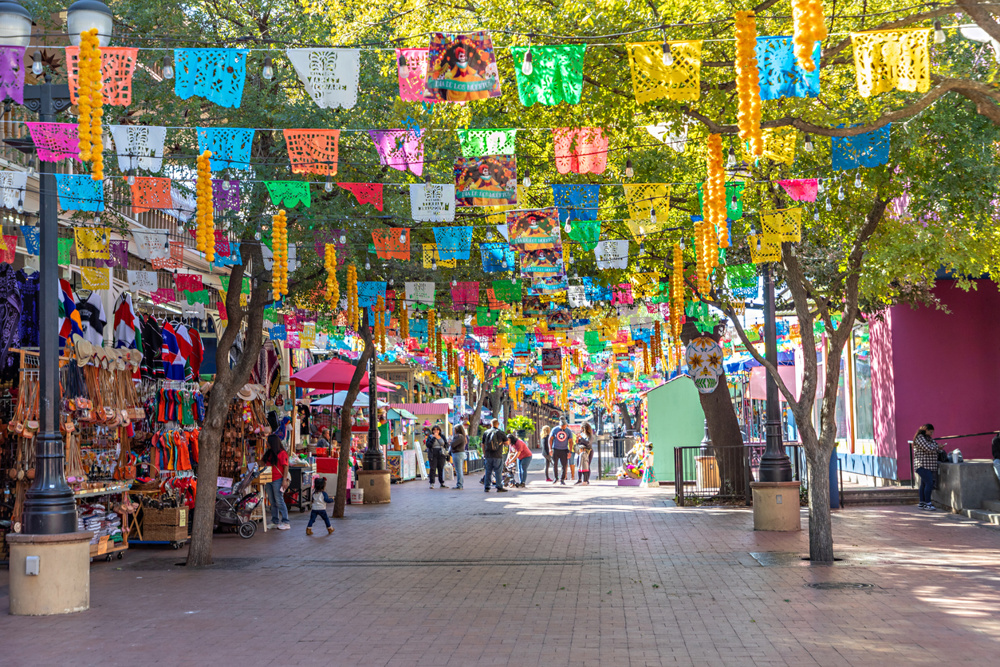
Historic Market Square, also called El Mercado, covers several downtown blocks and is widely recognized as the largest Mexican market in the United States.
The area includes locally owned shops, restaurants, bakeries, and vendors selling:
- Folk art
- Pottery
- Textiles
- Leather goods
- Jewelry
- Traditional clothing
- Imported crafts
Restaurants such as Mi Tierra Café y Panadería, which opened during the 1940s, helped turn the district into a major cultural and culinary destination.
Throughout the year, Market Square hosts mariachi performances, folklórico dancing, seasonal festivals, and cultural celebrations connected to San Antonio’s Mexican and Tex-Mex heritage.
The Tower of the Americas Still Dominates the Skyline
Built for the 1968 HemisFair World’s Fair, the Tower of the Americas remains one of San Antonio’s most recognizable landmarks.
The tower rises approximately 750 feet above ground level and includes observation areas overlooking downtown San Antonio and surrounding neighborhoods.
Visitors can experience:
- Panoramic city views
- Observation decks
- A revolving restaurant
- Interactive exhibits
- Seasonal events
The tower sits beside Hemisfair Park, a downtown public space that continues evolving with playgrounds, green spaces, restaurants, and family-friendly gathering areas.
La Villita Preserves One of San Antonio’s Oldest Neighborhoods
Located along the San Antonio River, La Villita Historic Arts Village began as one of the city’s earliest residential neighborhoods.
During the 18th and 19th centuries, the district housed Spanish soldiers, settlers, artisans, and later European immigrants. Over time, the neighborhood developed a mix of adobe, stone, and Victorian-style buildings.
Today, La Villita functions as an arts and cultural district filled with:
- Art galleries
- Local artisan shops
- Jewelry studios
- Small museums
- Cultural events
- Outdoor performances
The preserved architecture and walkable streets make it one of downtown San Antonio’s most distinctive historic areas.
Natural Bridge Caverns Features Massive Underground Chambers
Located north of San Antonio near New Braunfels, Natural Bridge Caverns is one of Texas’s largest commercial cave systems.
Discovered by students from St. Mary’s University in 1960, the caverns opened to the public a few years later and have since become one of the area’s most popular natural attractions.
Visitors can explore underground formations including:
- Stalactites
- Stalagmites
- Flowstones
- Massive cave chambers
- Underground passages
The attraction also includes adventure activities above ground such as zip rails, ropes courses, gem mining, and maze attractions.
The site gets its name from the large natural limestone bridge located near the cavern entrance.
San Fernando Cathedral Hosts “The Saga” Light Show
Located in Main Plaza downtown, San Fernando Cathedral is one of the oldest continuously functioning religious communities in the United States.
The cathedral’s facade becomes the centerpiece of “The Saga,” a projection-mapping light show created by French artist Xavier de Richemont.
The show uses animated imagery, music, and historical visuals to tell stories connected to San Antonio’s history, including:
- Spanish settlement
- Indigenous cultures
- The Alamo era
- Immigration
- Cultural traditions
- Modern city life
The nighttime projection has become one of downtown San Antonio’s best-known public art attractions.
Phil Hardberger Park’s Wildlife Bridge Connects Habitats
Phil Hardberger Park features one of the country’s most recognized urban wildlife crossings.
The Robert L.B. Tobin Land Bridge, opened in 2020, stretches across Wurzbach Parkway and reconnects habitat areas divided by traffic corridors.
The bridge was designed to help animals safely move between sections of the park while also giving visitors a place to walk and observe the landscape.
Wildlife recorded using the crossing includes:
- Deer
- Coyotes
- Raccoons
- Foxes
- Smaller mammals and reptiles
The structure has become both a conservation project and a popular public feature within San Antonio’s growing park system.
Conclusion
San Antonio’s combination of colonial history, riverfront attractions, cultural districts, natural landmarks, and modern public spaces gives the city a personality unlike any other place in Texas.
Whether exploring centuries-old missions, walking along the River Walk, visiting underground caverns, or discovering local art and Mexican heritage at Market Square, visitors encounter layers of history and culture woven throughout the city.
San Antonio continues balancing preservation and growth while remaining one of Texas’s most distinctive destinations.